
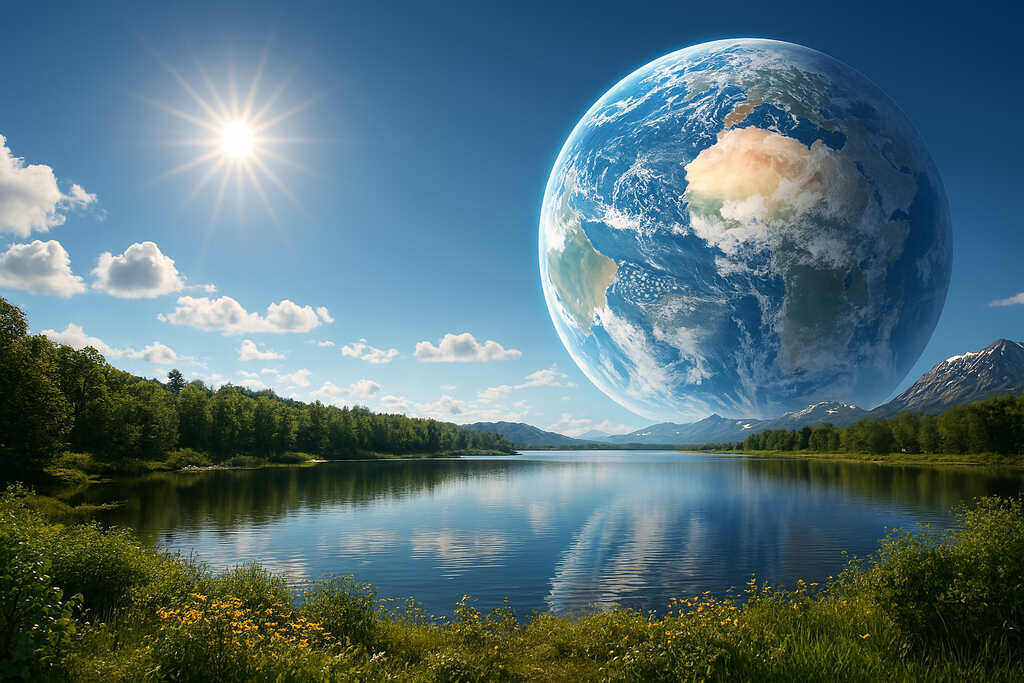
What makes Life possible on Earth is a question that has fascinated scientists, philosophers, and explorers for centuries. Life on our planet thrives because of a unique combination of factors, including the planet’s distance from the Sun, its atmosphere, and the availability of liquid water.
Understanding what makes Life possible on Earth involves examining the delicate balance of conditions that allow ecosystems to flourish, from microscopic organisms to complex animals. The interplay between energy, nutrients, and environmental stability ensures that life can exist in diverse forms. Exploring these factors helps answer the profound question: why does Earth support life when so many other planets appear barren?
1. Proximity to the Sun

The first and most critical factor in what makes Life possible on Earth is its perfect distance from the Sun. Situated within the habitable zone definition, Earth receives just the right amount of solar energy to maintain temperatures that support liquid water. This distance prevents the planet from becoming either too hot like Venus or too cold like Mars.
The Sun’s energy drives photosynthesis, influences climate patterns, and powers the water cycle, all essential to life. The energy received also sustains ecosystems from polar regions to tropical rainforests. Therefore, understanding conditions for life on Earth starts with recognizing the significance of solar proximity and its role in maintaining a stable, life-friendly environment.
2. Presence of Liquid Water

One of the most cited reasons for what makes Life possible on Earth is water. Importance of water for life on Earth cannot be overstated, as it serves as a solvent for biochemical reactions, transports nutrients, and regulates temperature. Oceans, rivers, and lakes create habitats for countless organisms.
Water’s unique properties, like its high heat capacity and surface tension, allow life to survive extreme conditions. For example, plankton in the oceans form the base of the food chain, relying entirely on water to thrive. Without water, cells cannot function, and life as we know it would be impossible. Thus, the availability of liquid water is fundamental to why Earth is habitable.
3. Protective Atmosphere

The atmosphere is essential for what makes Life possible on Earth, shielding the planet from harmful solar radiation while trapping heat to maintain a stable climate. Composed mainly of nitrogen and oxygen, it supports respiration for most life forms. Layers like the ozone absorb ultraviolet radiation, preventing cellular damage.
The atmosphere also circulates water and nutrients through wind patterns, contributing to diverse ecosystems. Without this protective envelope, life would be exposed to temperature extremes and radiation. The atmosphere’s balance is a direct example of conditions for life on Earth, highlighting how gaseous composition and circulation systems make Earth uniquely capable of sustaining life over billions of years.
4. Stable Climate

Climate stability is a crucial factor in what makes Life possible on Earth. The planet’s tilt, rotation, and orbit create predictable seasons that allow species to adapt and thrive. Stable climates prevent extreme temperature fluctuations, supporting long-term ecological balance. Tropical rainforests, temperate forests, and polar ecosystems all depend on climate patterns.
Additionally, ocean currents and atmospheric circulation distribute heat globally, reducing harsh environmental extremes. These stable systems exemplify why Earth is habitable, as they allow plants and animals to evolve in consistent conditions. Understanding climate stability provides insight into the broader conditions for life on Earth, demonstrating that even minor shifts can dramatically affect ecosystems.
5. Magnetic Field Protection

Earth’s magnetic field contributes to what makes Life possible on Earth by deflecting harmful solar and cosmic radiation. Without this geomagnetic shield, charged particles from the Sun would strip the atmosphere over time, endangering life. The field also helps maintain climate stability by preserving atmospheric integrity.
Its protection ensures that delicate biochemical processes are not disrupted by radiation, particularly near the poles where solar winds are most intense. Planets like Mars, which lack a strong magnetic field, highlight the dangers of exposure. The magnetic field is thus an essential element of conditions for life on Earth, demonstrating another layer of defense that makes Earth habitable.
6. Nutrient-Rich Soil

Soil fertility is vital in what makes Life possible on Earth because it sustains plant growth, which forms the base of terrestrial food chains. Rich in minerals like nitrogen, phosphorus, and potassium, healthy soil supports agriculture and natural vegetation. Microorganisms in the soil recycle organic matter, enhancing nutrient availability and sustaining ecosystems.
Soils vary worldwide, creating diverse habitats and influencing the distribution of species. Without fertile soil, terrestrial ecosystems would collapse, and human civilization could not thrive. This illustrates conditions for life on Earth where both chemical composition and ecological processes interact to maintain life-supporting environments.
7. Oxygen-Rich Atmosphere

An oxygen-rich atmosphere is another key factor in what makes Life possible on Earth. Oxygen is essential for cellular respiration in animals and many microorganisms. Its presence also facilitates the formation of the ozone layer, which protects life from ultraviolet radiation. Early Earth saw a gradual accumulation of oxygen during the Great Oxidation Event, transforming the biosphere and allowing complex life to evolve.
The oxygen balance is delicate—too little would prevent complex life, while too much could increase the risk of fires. Studying oxygen’s role helps us understand why Earth is habitable and the intricate conditions for life on Earth that evolved over billions of years.
8. Plate Tectonics

Plate tectonics plays a surprising role in what makes Life possible on Earth by recycling carbon, regulatingthe climate, and creating diverse habitats. Movement of tectonic plates drives volcanic activity, releasing gases that stabilize the atmosphere. Mountain formation creates varied ecosystems, while earthquakes and tectonic shifts influence nutrient cycles.
These dynamic processes prevent extreme climate extremes by moderating carbon dioxide levels. Without tectonics, the planet could face runaway greenhouse effects or nutrient-depleted surfaces. Studying plate tectonics provides insight into conditions for life on Earth, highlighting how geological activity maintains long-term environmental stability essential for survival.
9. Biodiversity

Biodiversity directly impacts what makes Life possible on Earth by creating resilient ecosystems. Species interact in food webs, recycling nutrients, controlling populations, and maintaining ecological balance. Coral reefs, rainforests, and wetlands exemplify how diversity enhances ecosystem stability. A single species loss can ripple across a habitat, demonstrating the fragility of life.
Biodiversity also supports human needs, providing food, medicine, and ecosystem services. Protecting this diversity ensures why Earth is habitable for future generations. The complex interactions between species reveal conditions for life on Earth where ecological networks sustain both microscopic and large-scale life forms.
10. Sunlight Availability

Sunlight is essential in what makes Life possible on Earth, powering photosynthesis and driving the energy flow of ecosystems. Solar energy warms the planet, fuels plant growth, and influences behavioral patterns in animals. Plants convert sunlight into chemical energy, which then supports herbivores and predators in food webs.
Regions with abundant sunlight, like tropical rainforests, showcase extraordinary biodiversity due to energy availability. Even aquatic ecosystems depend on light penetration for algae and phytoplankton. Sunlight’s consistent energy supply exemplifies conditions for life on Earth, illustrating why Earth is habitable compared to planets with limited or inconsistent solar exposure.
11. Oceans as Climate Regulators

Oceans play a critical role in what makes Life possible on Earth by storing and redistributing heat globally. They moderate temperature extremes, influence weather patterns, and absorb carbon dioxide, mitigating climate change. Marine ecosystems, from coral reefs to deep-sea vents, support a vast array of life, sustaining global biodiversity.
Currents like the Gulf Stream maintain temperature balance across continents. Oceans also act as a water reservoir, facilitating the hydrological cycle. Their regulating functions highlight conditions for life on Earth, demonstrating why the presence of vast liquid bodies contributes significantly to why Earth is habitable.
12. Stable Planetary Orbit

Earth’s relatively circular orbit around the Sun ensures a predictable climate, which is crucial in what makes Life possible on Earth. This stable orbit prevents extreme seasonal fluctuations, allowing ecosystems to adapt and thrive. Planets with elliptical orbits experience severe temperature swings, making life challenging.
A consistent orbital path ensures the availability of sunlight, regulates water cycles, and maintains the delicate balance required for conditions for life on Earth. Understanding orbital stability helps scientists explore why Earth is habitable and why similar planets might be rare in the cosmos.
13. Carbon Cycle Balance

The carbon cycle is fundamental to what makes Life possible on Earth, regulating greenhouse gases and stabilizing the climate. Carbon is exchanged among the atmosphere, oceans, and living organisms, supporting photosynthesis and respiration. This balance prevents extreme warming or cooling, sustaining life over geological timescales.
Plants, algae, and soil microorganisms act as carbon sinks, while volcanic activity and respiration release it back. Disruptions, such as human-driven emissions, demonstrate the fragility of this system. The carbon cycle exemplifies conditions for life on Earth, emphasizing the importance of ecological processes in maintaining a habitable planet and why Earth is habitable.
14. Moon’s Gravitational Influence

The Moon’s gravity significantly impacts what makes Life possible on Earth by stabilizing the planet’s tilt and influencing ocean tides. Tidal movements support marine ecosystems and nutrient mixing. A stable axial tilt prevents extreme seasonal changes, allowing species to adapt to predictable climates. Without the Moon, Earth could experience chaotic climate variations, disrupting conditions for life on Earth.
Tides also shaped early coastal habitats, fostering the evolution of land species. Understanding the Moon’s influence illustrates one of the many cosmic factors contributing to why Earth is habitable, highlighting the interconnectedness of celestial mechanics and life.
15. Essential Chemical Elements

The availability of essential elements like carbon, hydrogen, nitrogen, oxygen, phosphorus, and sulfur explains what makes Life possible on Earth. These elements form the building blocks of proteins, nucleic acids, and other biomolecules. Their abundance in the crust, atmosphere, and oceans ensures that life can develop and sustain itself.
Variations in element availability can limit growth or prevent complex life. Geological processes, biological recycling, and atmospheric circulation maintain a balance of these chemicals. This elemental foundation highlights conditions for life on Earth and emphasizes why Earth is habitable, demonstrating that life’s existence depends on both physical and chemical planetary conditions.