

This Mindfulness Walk Script is designed for meditation professionals who wish to guide clients through a structured, accessible walking meditation experience. This provides a practical framework you can use in parks, quiet streets, nature trails, or indoor corridors to support grounding, stress relief, and nervous system regulation. The structure emphasizes posture and breath awareness, then gradually expands into sensory anchoring through sound, sight, touch, and open awareness, supported by gentle redirection and compassionate inner dialogue.
You may encourage clients to wear comfortable shoes, silence their phones, and adopt an easy, unforced pace. Model a soft gaze and nonjudgmental language, normalizing distraction and returning attention to steps and breath as needed. This Mindfulness Walk Script can be read live while walking together or recorded for group or one-on-one use. Timing remains flexible, with five to fifteen minutes fitting most settings.
Let’s get started.
Mindfulness Walk Script:
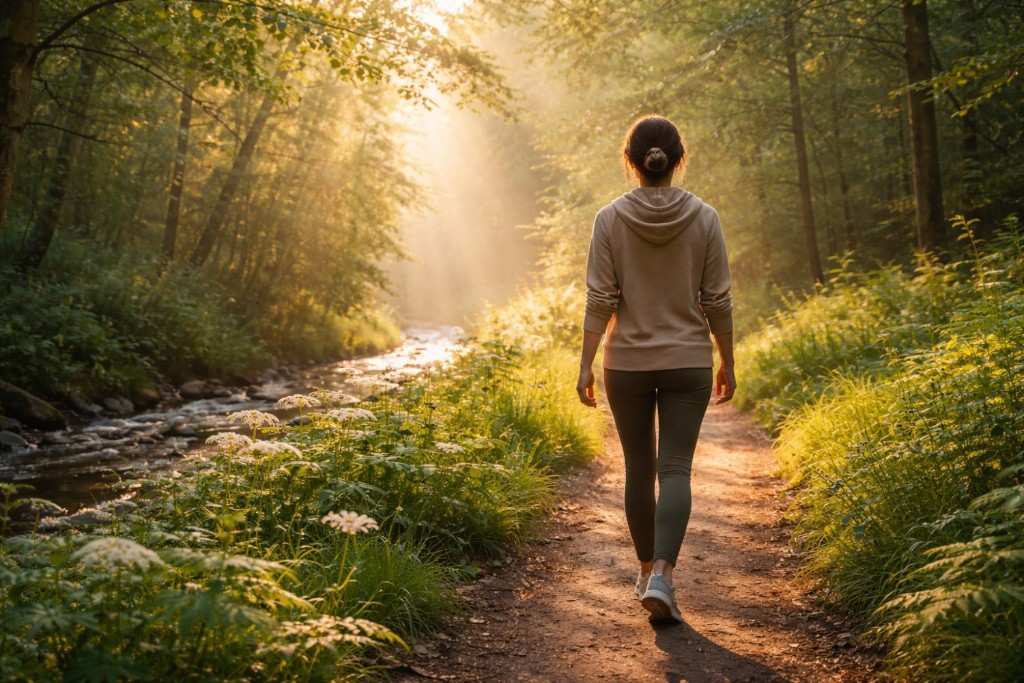
Begin by standing tall and relaxed, feet hip-width apart. Let your arms hang naturally at your sides. Soften your jaw, relax your shoulders, and invite a slow inhale through the nose, then a gentle exhale through the mouth. Notice the ground supporting you. Feel the contact points—heels, balls of the feet, toes. Let the spine lengthen, crown lifting slightly as if guided by a string from above.
Before taking your first step, take three steady breaths. On each inhale, silently say “arriving.” On each exhale, silently say “here.” You are arriving, here. Allow your gaze to be soft and about a few steps ahead of you. There’s no rush.
Begin to walk at a comfortable, unforced pace. Let the feet roll from heel to toe. Notice the subtle choreography of your body: ankles flexing, knees releasing, hips flowing, arms gently swinging. As you settle into the rhythm, place attention on the breath. Inhale for a natural count that feels easy; exhale just as naturally. No need to control—simply notice.
If your mind wanders—toward tasks, conversations, or worries—acknowledge the thought kindly and come back to the sensation of walking: the touch of your foot meeting the earth, the rise and fall of your breath, the movement of your arms. Let the environment support your practice. Sense the air on your skin—the temperature, the slight breeze, the way sunlight or shade touches you. Listen for layers of sound: perhaps leaves rustling, distant traffic, birds, footsteps. Hear without labeling, noticing volume, pitch, and rhythm. Let sounds come and go like waves.
Shift attention to sight. With a soft, panoramic gaze, take in colors, shapes, and light. Notice edges and shadows, the contrast between stillness and movement. If you find your eyes locking onto a single object, gently widen your view to include the whole scene. This is open awareness: seeing without grasping.
Now bring attention to touch. Feel the fabric against your skin, the swing of your coat, the placement of your hands—maybe in pockets, maybe relaxed at your sides. Feel the micro-adjustments your body makes to keep you balanced. These subtle sensations anchor you here and now.
Return to the cadence of your steps. Perhaps silently count: one, two, one, two—or match steps to breath: two steps on the inhale, two on the exhale. If your breath prefers another ratio, let it lead. The goal is not control, but companionship with your own body.
At this midpoint, pause your walk for a moment. Stand still and place one hand over your chest, one over your belly. Inhale to meet your hand; exhale to soften beneath your hand. Sense your heartbeat. Offer yourself a kind phrase: “May I walk with ease. May I be present?” When ready, resume moving.
As thoughts reappear, greet them with friendliness. Imagine each thought as a leaf floating downstream. You don’t have to chase it; you don’t have to push it away. Let the stream carry it. Return to your steps, breath, and senses. This is the heart of a mindfulness walk script—coming back, gently, again and again.
Now, expand gratitude. With each step, silently thank your feet for carrying you, your legs for their strength, your lungs for breathing you. Notice any shift in mood—a touch more space, a hint of calm. If tension lingers, imagine exhaling it into the ground and inhaling steadiness from the earth.
If you encounter a hill, stairs, or uneven path, treat it as a teacher in balance and patience. Slow down. Widen your stance. Feel the body coordinate. Let the challenge be part of the meditation. If you’re walking indoors, the hallway becomes a landscape of detail: light on the wall, the sound of your steps, the air in the room. Presence is portable.
As you near the end, gradually shorten your attention from the wider scene back to body and breath. Sense the full arc of your practice: beginning, middle, and close. Acknowledge any clarity or softening that has appeared. Remind yourself that you can return to this mindfulness walk script anytime—in five minutes or fifty—because presence is not a place, but a way of meeting each step.
Find a comfortable place to pause. Stand tall, relax your shoulders, and take a slow inhale, then a longer exhale. Offer yourself one final phrase: “I am here.” Let that be enough. With gratitude, close your practice, carrying forward the steadiness you’ve grown with this mindfulness walk script.