
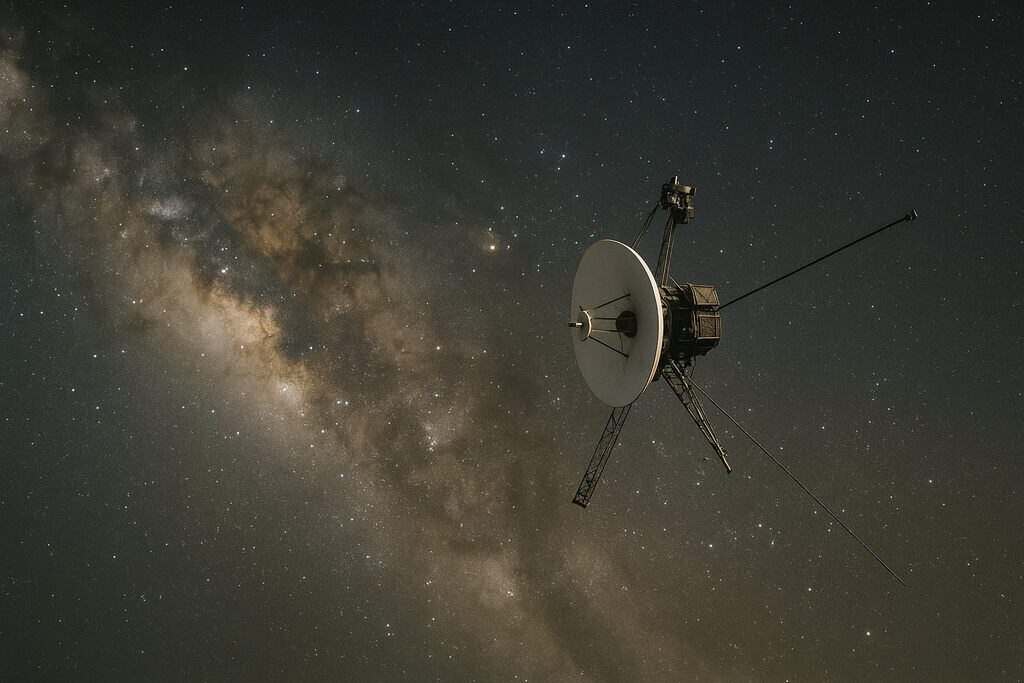
In 1977, NASA launched two small spacecraft—Voyager 1 and Voyager 2—on what began as a simple mission to explore the outer planets. No one imagined that decades later, one of them would still be traveling through space, billions of miles from Earth.
Voyager 1 has gone farther than any human-made object in history. It’s not just a machine—it’s a messenger carrying our story across the stars. Its journey reminds us that curiosity knows no limits and that even the smallest steps can lead to the most extraordinary distances.
1. The Dream That Started It All
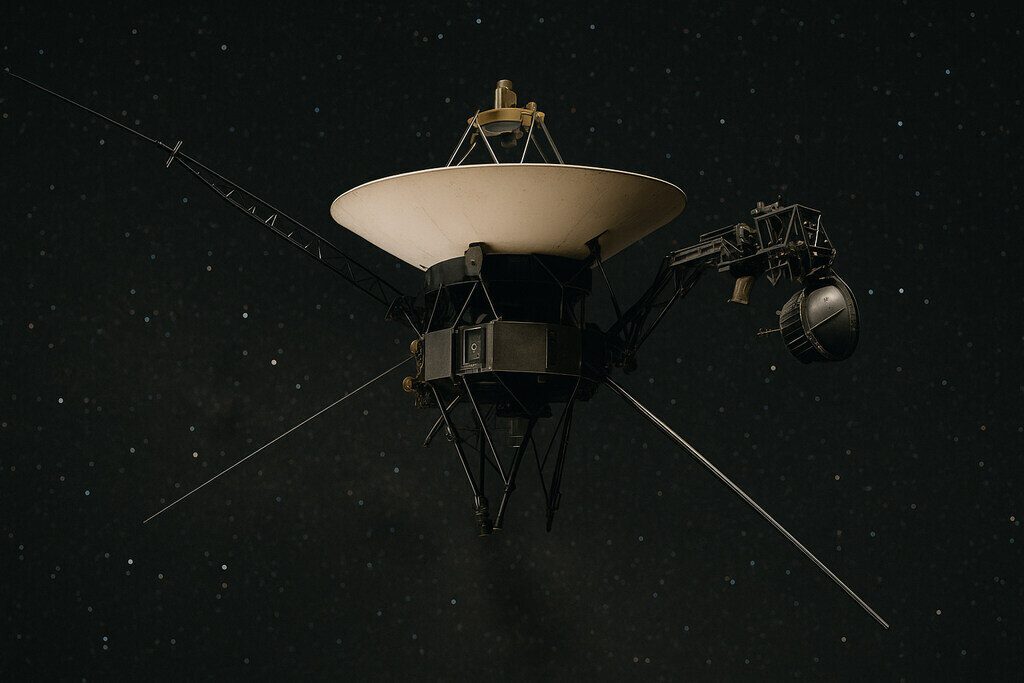
Voyager 1 was born out of an ambitious dream: to see the outer planets up close. In the 1970s, a rare planetary alignment—one that happens only once every 176 years—offered a unique chance for a spacecraft to slingshot from one planet to another using gravity assists. NASA seized the moment. Scientists and engineers from all over the world collaborated to create a spacecraft capable of surviving the cold, radiation, and emptiness of deep space.
What started as a short mission to Jupiter and Saturn soon became something much greater: humanity’s first true step toward the stars. The team behind Voyager didn’t just want data; they wanted discovery. They believed that exploring the unknown could unite people through wonder. That belief continues to echo today as Voyager 1 carries humanity’s curiosity beyond the edge of our solar system.
2. The Power of Gravity Assist
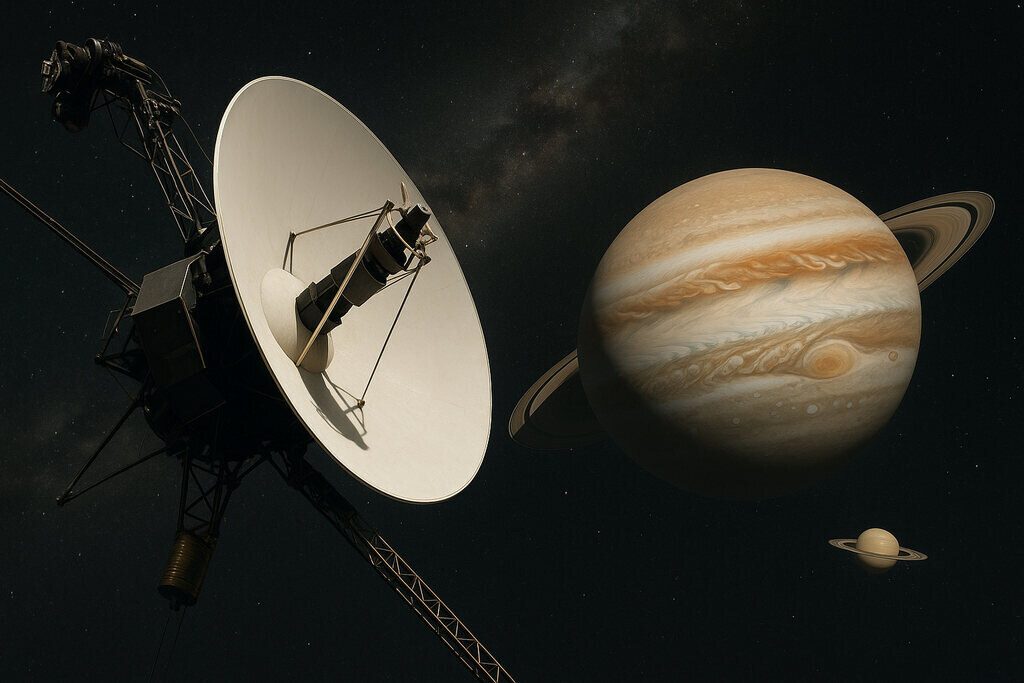
Voyager 1’s incredible speed wasn’t achieved by rocket fuel alone—it was powered by gravity itself. The spacecraft used a clever technique called a “gravity assist,” or slingshot maneuver, to gain momentum from the planets it passed. By flying close to Jupiter and Saturn, Voyager 1 stole a bit of their orbital energy, accelerating toward the edge of the solar system without using extra fuel.
This efficient trick turned a modest spacecraft into a record-breaker. Gravity assists not only made Voyager’s long journey possible but also inspired the design of many future missions, including Galileo and New Horizons. This smart use of physics showed that deep-space travel doesn’t always require giant engines—sometimes, all you need is a good plan and a deep understanding of nature’s laws.
3. The Grand Tour of the Outer Planets
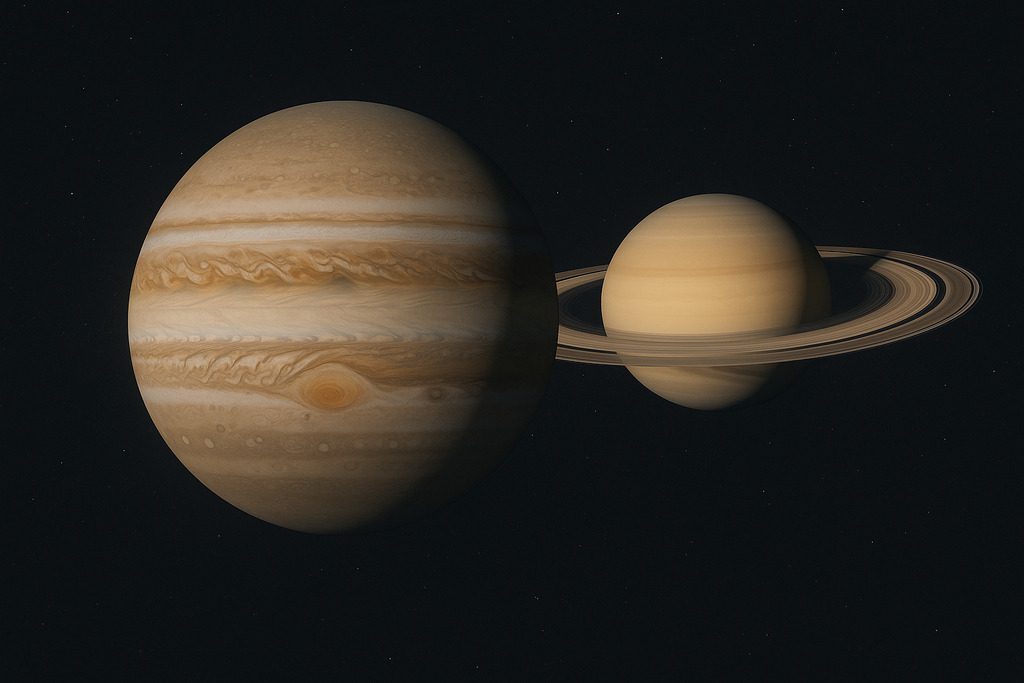
Originally, Voyager 1’s mission was to visit Jupiter and Saturn. Its twin, Voyager 2, would continue to Uranus and Neptune. Voyager 1’s cameras sent back jaw-dropping images of Jupiter’s swirling storms, volcanic moons, and Saturn’s elegant rings. It revealed active volcanoes on Io, lightning in Jupiter’s atmosphere, and complex structures in Saturn’s rings that no one had ever seen before.
These discoveries reshaped our understanding of the solar system. Each photo felt like opening a window into a new world. For scientists, it was like meeting neighbors they never knew existed. For the public, it sparked a sense of wonder that made space exploration feel real, personal, and meaningful.
4. The Golden Record: Humanity’s Message in a Bottle
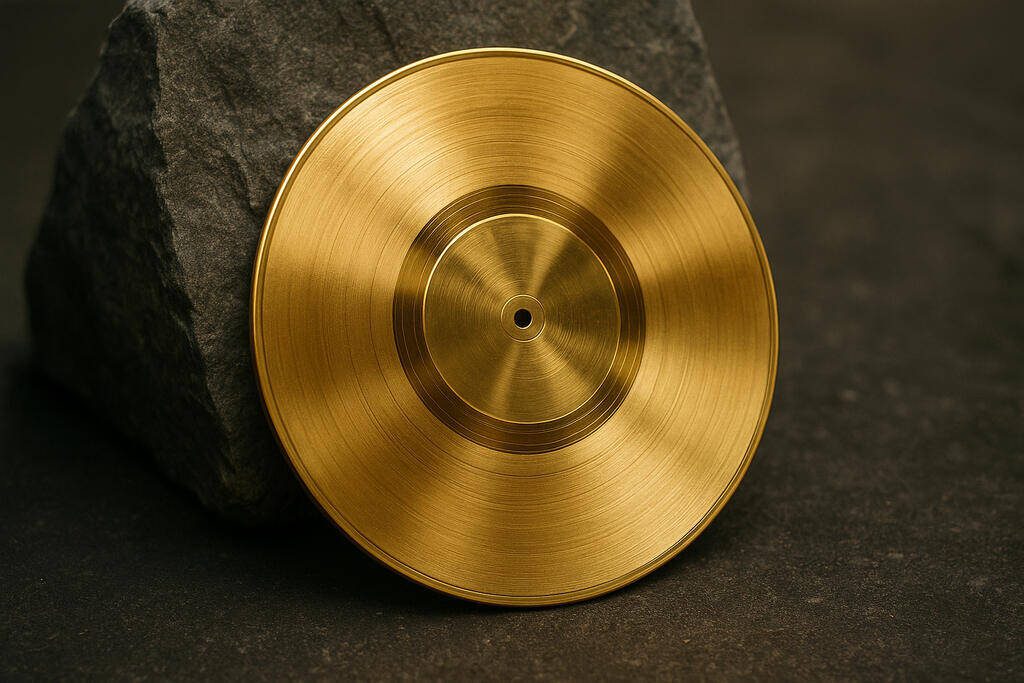
Perhaps the most poetic part of Voyager 1 is the Golden Record—a 12-inch gold-plated copper disc carrying sounds and images from Earth. It includes greetings in 55 languages, natural sounds like thunder and birdsong, and music ranging from Bach to Chuck Berry. It also contains photographs of people, animals, and landscapes.
The record was designed to last billions of years, a message for any intelligent life that might someday find it. Carl Sagan, who helped design the record, called it “a bottle cast into the cosmic ocean.” It’s a timeless reminder that Voyager doesn’t just represent technology—it represents us, our culture, and our hope that we’re not alone in the universe.
5. Surviving the Harshness of Space
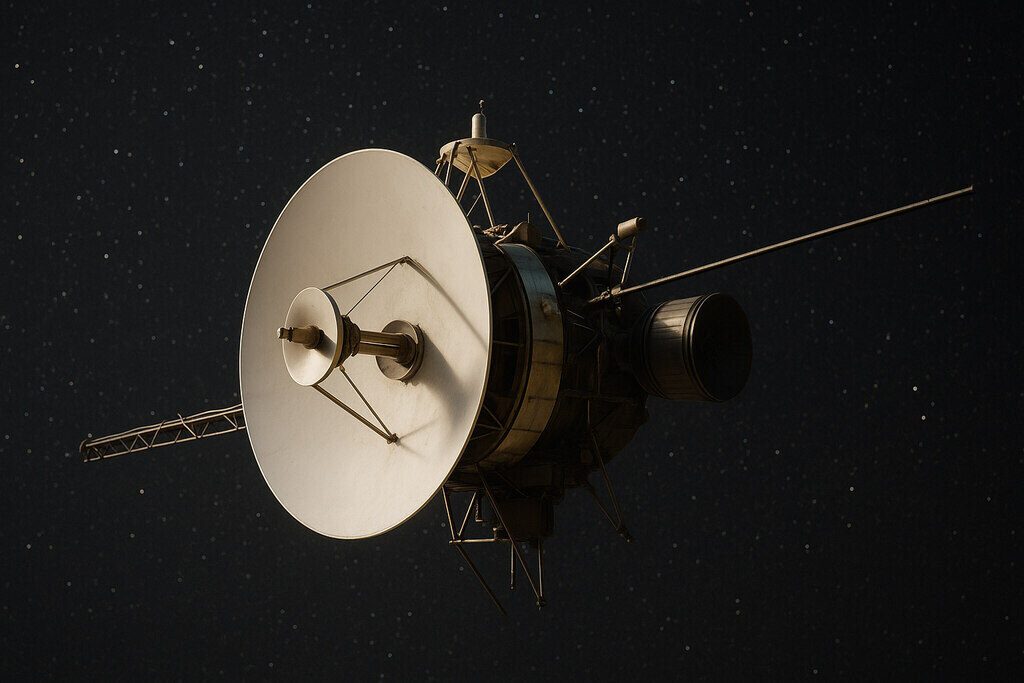
Space is unforgiving—freezing cold, bombarded by radiation, and full of micrometeorites. Yet Voyager 1 was built to last. Its aluminum and titanium shell protects its delicate instruments, while a layer of insulation shields it from extreme temperatures. Power comes from three nuclear batteries called RTGs (radioisotope thermoelectric generators), which convert the heat from decaying plutonium into electricity.
These RTGs are still working after almost 50 years, though their output slowly decreases. The spacecraft’s resilience is a tribute to 1970s engineering—proof that careful planning and craftsmanship can outlast expectations. Even now, as its instruments grow weaker, Voyager 1 continues to send data home from billions of miles away.
6. The Journey Beyond Saturn
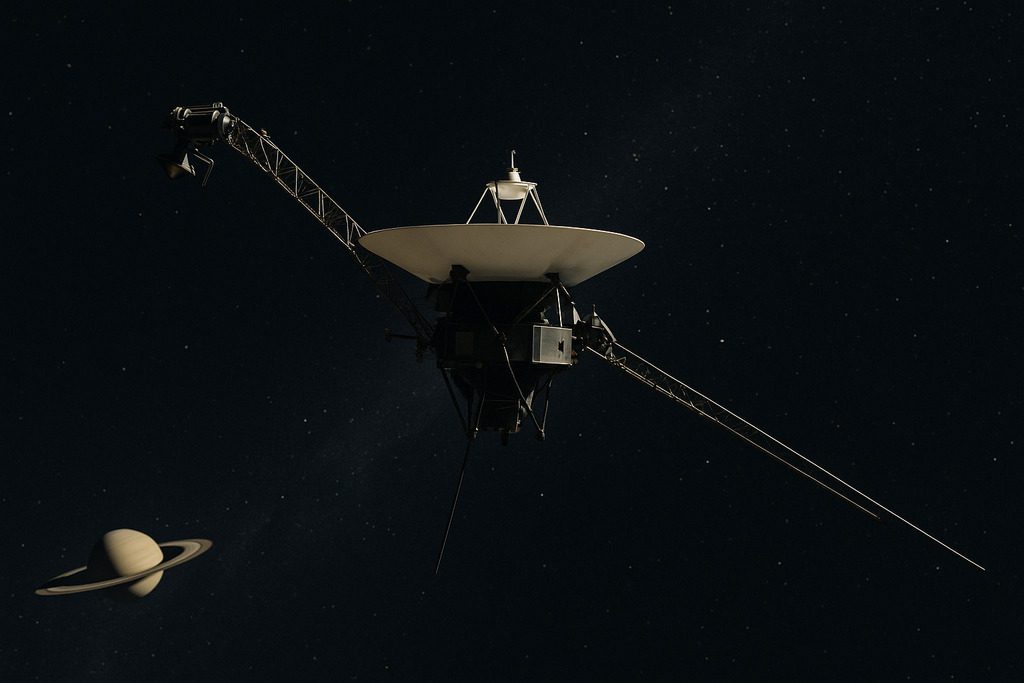
After completing its studies of Saturn and its largest moon, Titan, Voyager 1’s path took it on a one-way trip out of the solar system. Unlike Voyager 2, which continued to Uranus and Neptune, Voyager 1’s trajectory sent it upward, out of the plane of the planets.
This decision was made to give it the best possible view of Titan’s thick atmosphere—but it also meant it would become humanity’s first interstellar traveler. By 1980, its planetary mission was over. Everything from that point forward became bonus science—a long, silent voyage into the great unknown, where no spacecraft had gone before.
7. A Long Goodbye: Contact with Earth
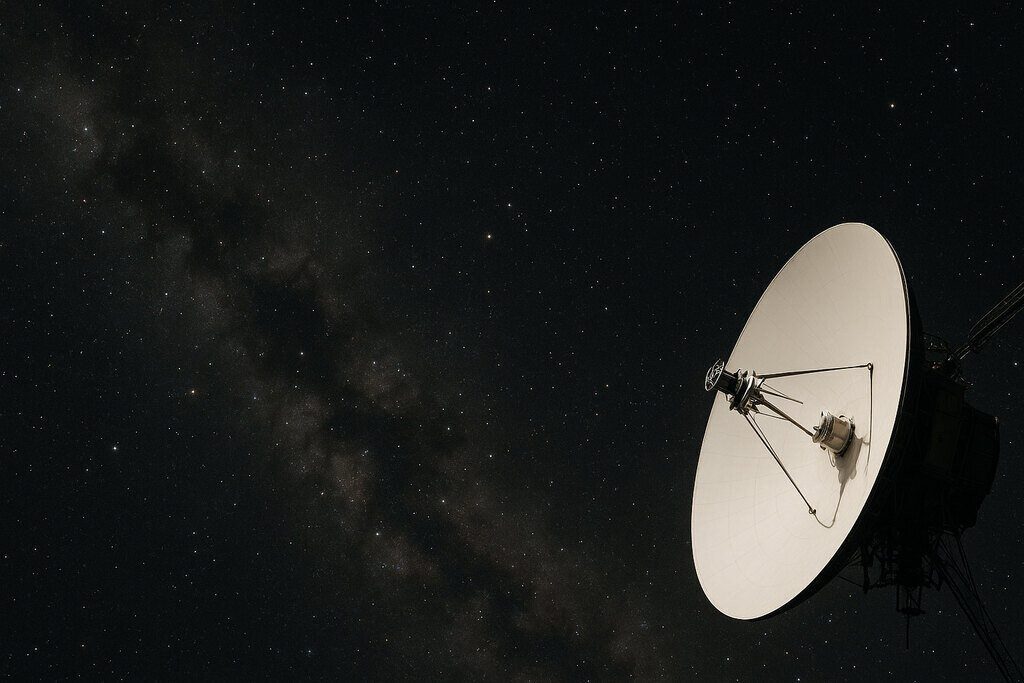
Communicating with Voyager 1 is one of the most remarkable feats in human history. Its radio signals, traveling at the speed of light, take over 22 hours to reach Earth. NASA’s Deep Space Network—massive radio antennas located in California, Spain, and Australia—keeps the connection alive. Engineers send commands, and Voyager responds faintly, whispering through the void.
Each bit of data that returns is a triumph of patience and precision. Maintaining contact requires powerful transmitters, ultra-sensitive receivers, and a deep understanding of how to talk to a 1970s computer that’s billions of miles away. It’s like having a conversation with a time capsule floating in eternity.
8. Discovering the Edge of the Solar System
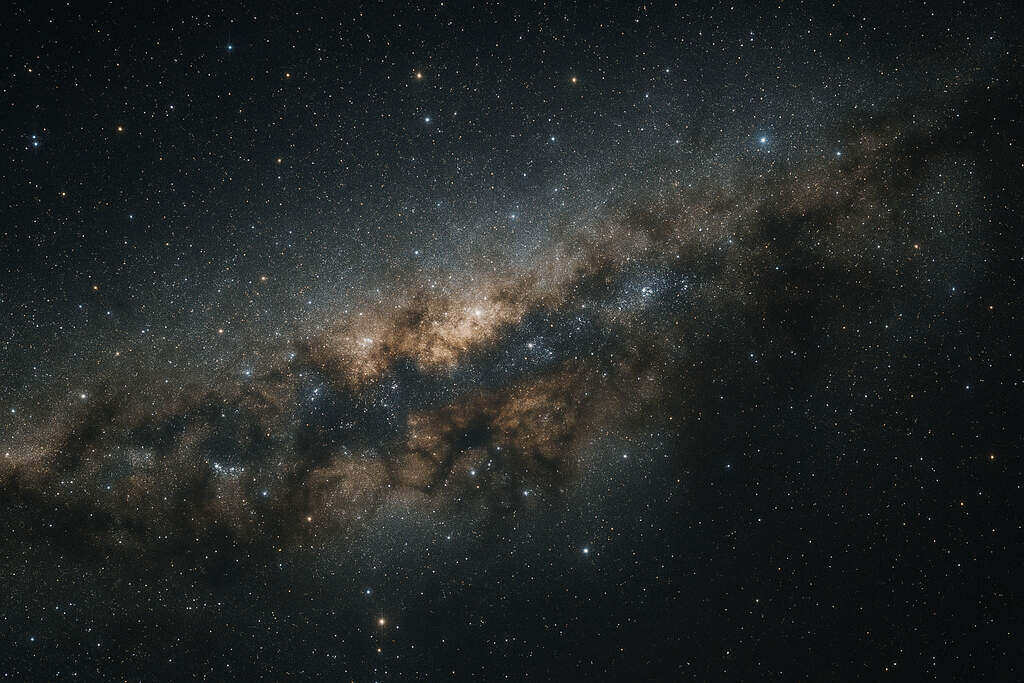
As Voyager 1 ventured farther, it reached a region known as the heliosphere—the bubble created by the Sun’s magnetic field and solar wind. In 2012, scientists confirmed that Voyager 1 had crossed the heliopause, the boundary where solar influence ends and interstellar space begins. This was a historic milestone: for the first time, a human-made object had entered the space between the stars.
Instruments aboard Voyager measured changes in particle density, confirming that it had left the protective bubble of the Sun. That moment wasn’t just scientific—it was deeply symbolic. Humanity had extended its reach beyond its birthplace.
9. What Voyager 1 Sees Today
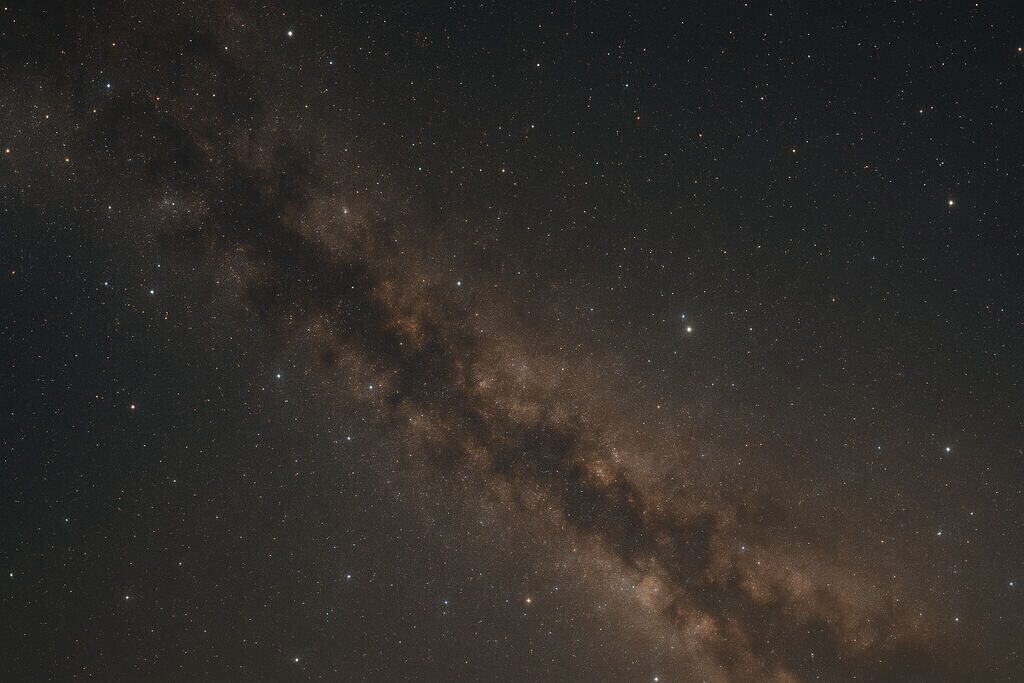
At over 15 billion miles from Earth, Voyager 1 no longer sends pictures—it doesn’t have the power for that. Instead, it measures cosmic rays, magnetic fields, and particles in interstellar space. These readings help scientists understand the environment beyond our solar system—something no other spacecraft can do.
Even now, Voyager 1 is teaching us how the Sun interacts with the galaxy around it. Each piece of data is precious, like a postcard from the edge of forever. It reminds us that exploration isn’t just about pretty pictures—it’s about knowledge, persistence, and curiosity that never fades.
10. The Pale Blue Dot Moment
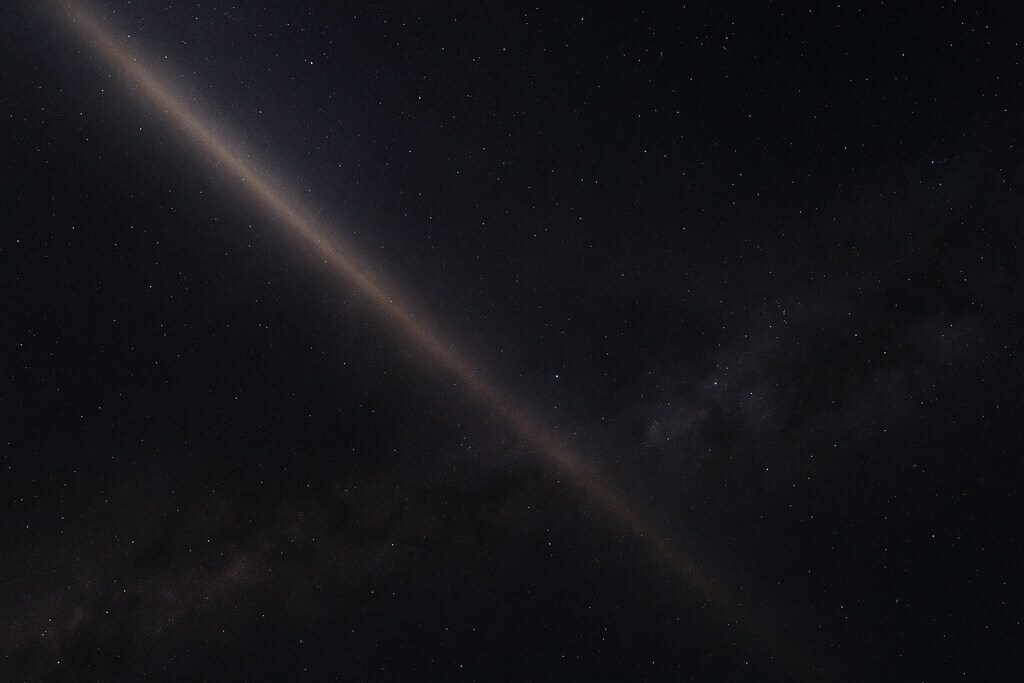
Before shutting down its cameras in 1990, Voyager 1 turned around and took one last photograph of Earth from 3.7 billion miles away. In that image, our planet appeared as a speck—a “pale blue dot”—floating in a sunbeam.
Carl Sagan’s reflection on this photo remains one of the most moving pieces of writing in science: “All of human history has happened on that tiny pixel.” That image changed how people viewed Earth—not as a vast world, but as a fragile home shared by everyone. It reminded us that in the grand cosmic scale, unity and care for our planet are what truly matter.
11. The Challenge of Keeping It Alive
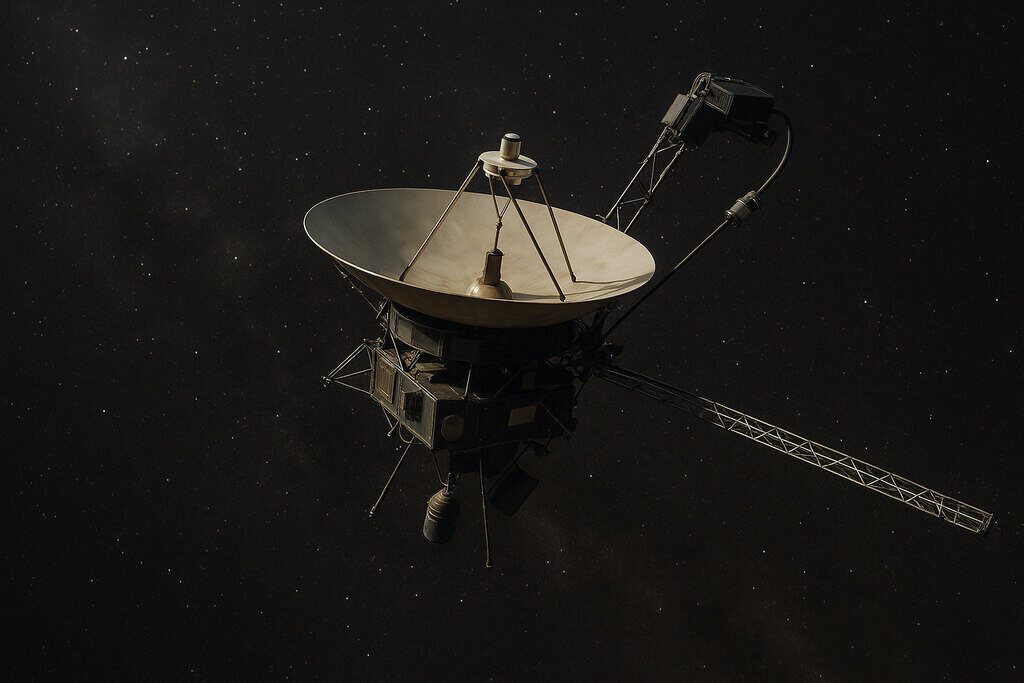
Voyager 1 is now operating on borrowed time. Its power supply weakens by about 4 watts per year, forcing NASA engineers to make difficult choices about which instruments to keep running. Some systems have been turned off to conserve energy. Yet, the spacecraft keeps communicating, thanks to creative problem-solving.
Engineers have even reprogrammed it from billions of miles away using 1970s software—a nearly impossible task. Each successful fix feels like breathing life back into an aging explorer who refuses to stop. It’s a lesson in resilience, resourcefulness, and dedication to discovery.
12. Voyager’s Legacy in Modern Missions
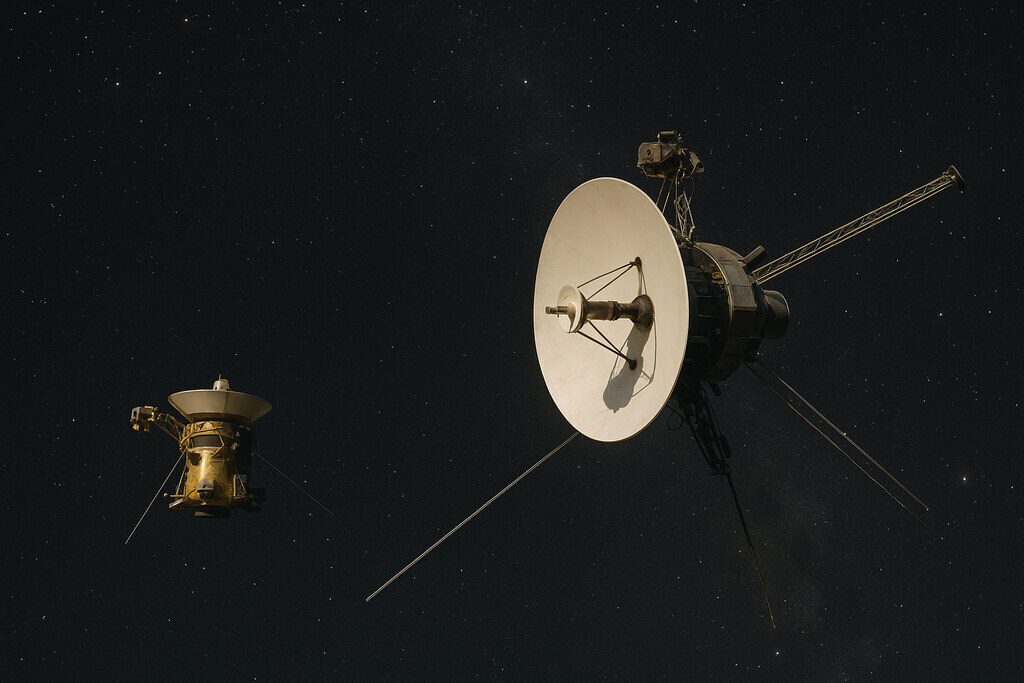
Voyager paved the way for future space exploration. Without it, there might not have been missions like Cassini (to Saturn), Juno (to Jupiter), or New Horizons (to Pluto). Voyager showed that small, well-built spacecraft could travel vast distances and deliver groundbreaking results.
It also changed how scientists design long-term missions—teaching them how to build systems that last for decades. Every spacecraft launched since carries a bit of Voyager’s DNA: the courage to explore, the drive to learn, and the dream of reaching beyond what’s known.
13. Humanity’s Message to the Stars
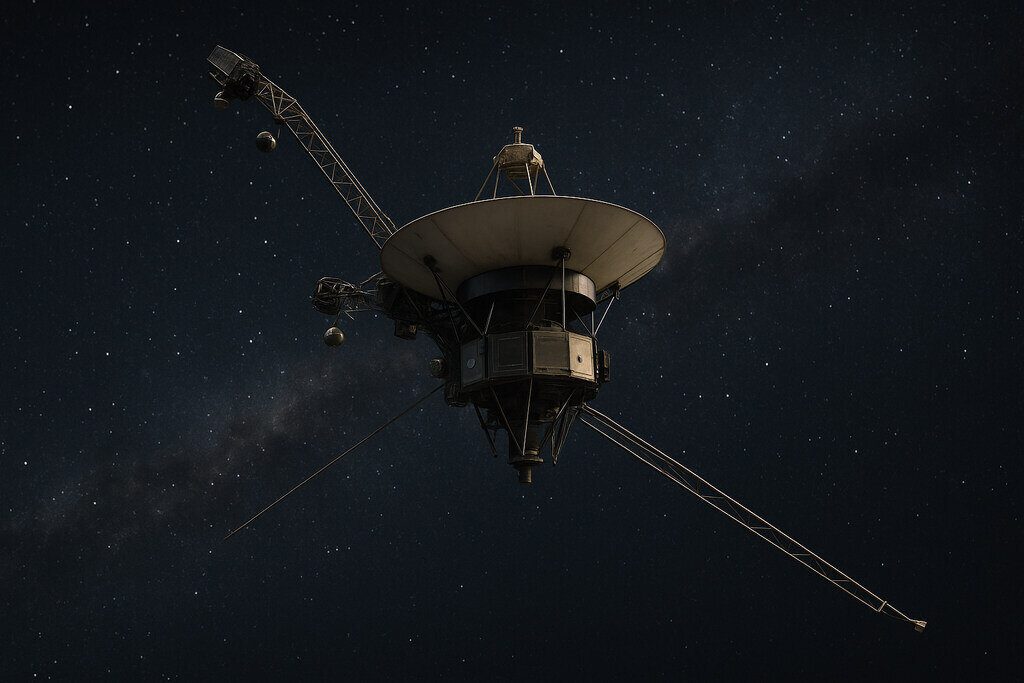
Voyager 1’s continued journey makes it a silent ambassador for all humankind. Even after its systems shut down, it will keep traveling for billions of years. Long after Earth is gone, the Golden Record will still carry our sounds and images across the galaxy. That idea is both humbling and inspiring. Voyager reminds us that exploration isn’t just about science—it’s about legacy. It’s about leaving a trace of who we were, so that, someday, somewhere, someone might know we once looked up and wondered.
14. Lessons from Voyager’s Journey
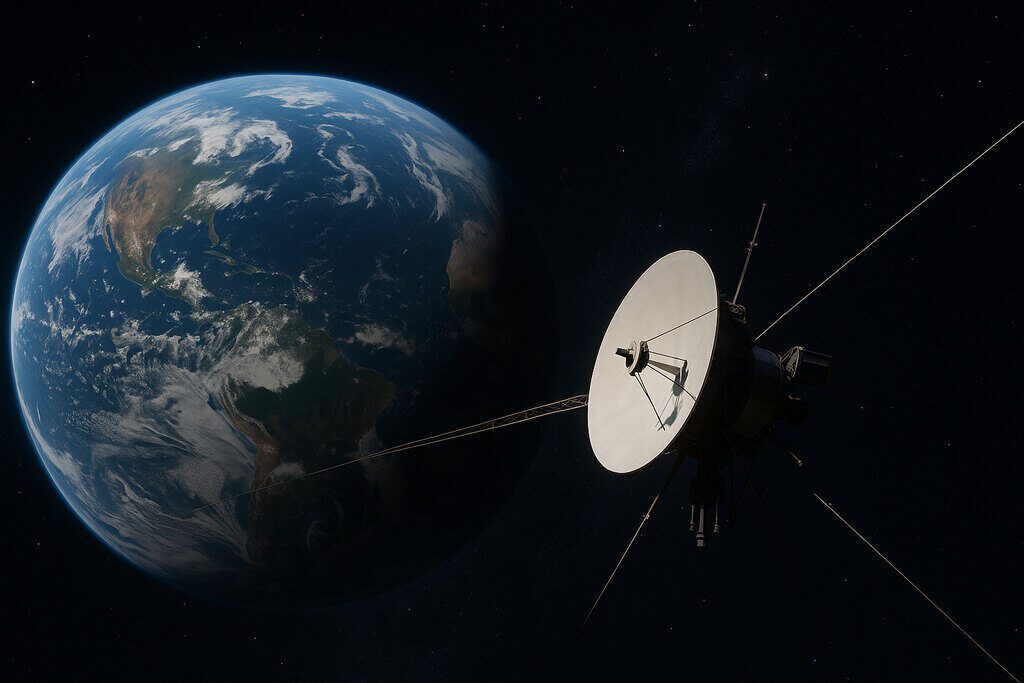
Voyager’s story teaches timeless lessons: that small beginnings can lead to unimaginable achievements, that persistence outlasts power, and that curiosity is the engine of progress. It shows how teamwork, ingenuity, and optimism can push the limits of what’s possible.
Voyager wasn’t built by one person—it was built by thousands who believed in something bigger than themselves. Its endurance proves that human creativity can survive even the cold silence of space. Every day it still speaks to Earth, it tells us one thing loud and clear: “Never stop exploring.”
15. The Endless Journey Ahead
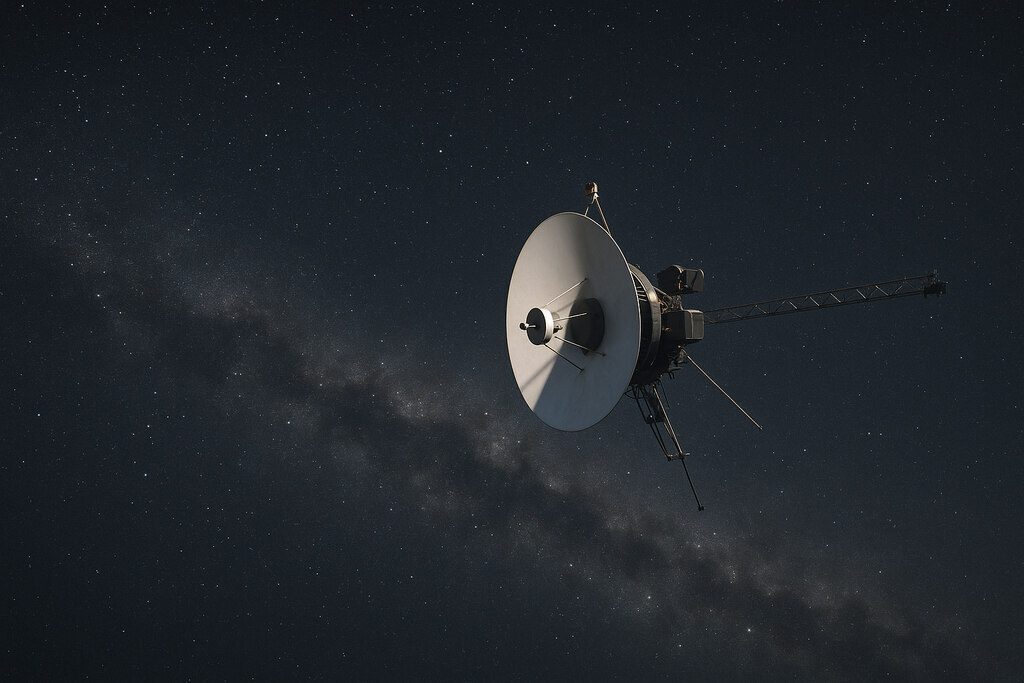
Voyager 1 will keep traveling long after its power fades, moving through interstellar space toward the constellation Ophiuchus. In about 40,000 years, it will pass within two light-years of another star. Even then, its message will still be intact. Though its voice will eventually go silent, its legacy will echo forever in science, culture, and imagination. Voyager 1 isn’t just a spacecraft—it’s a symbol of human courage and curiosity. It reminds us that exploration is not about where we go, but why we go: to seek, to learn, and to connect with something greater than ourselves.
Conclusion
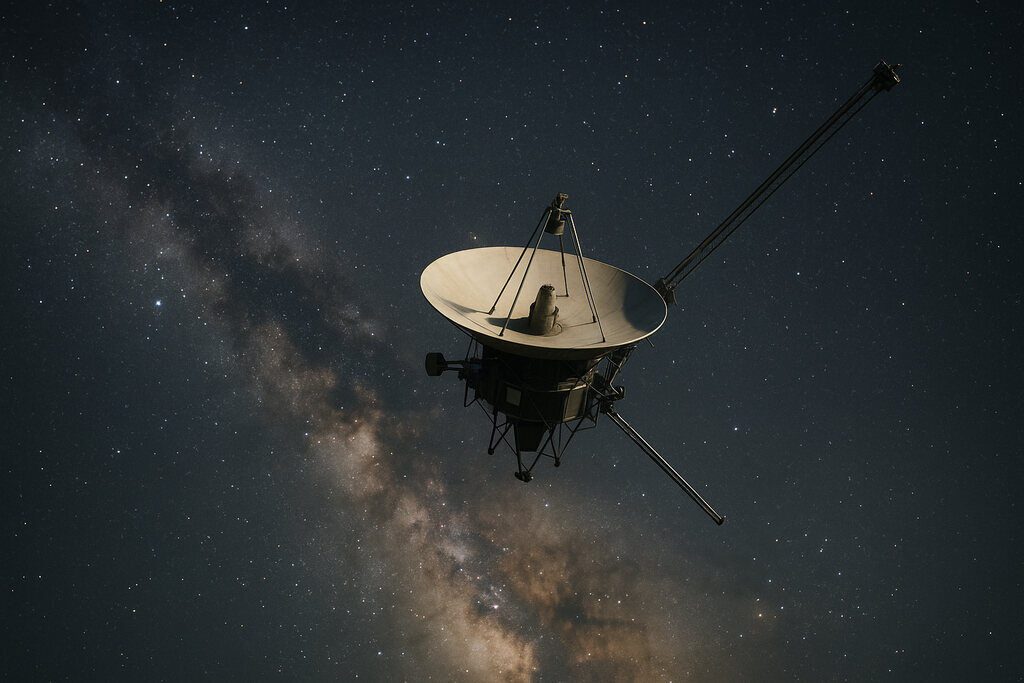
Voyager 1 began as a mission to study planets—but became a story about what it means to be human. It’s a story of adventure, endurance, and hope. As it drifts farther into the stars, it carries with it a piece of all of us. Its journey proves that no distance is too great for curiosity, no boundary too far for imagination. Voyager 1 is more than a traveler—it’s humanity’s eternal handshake with the universe.